
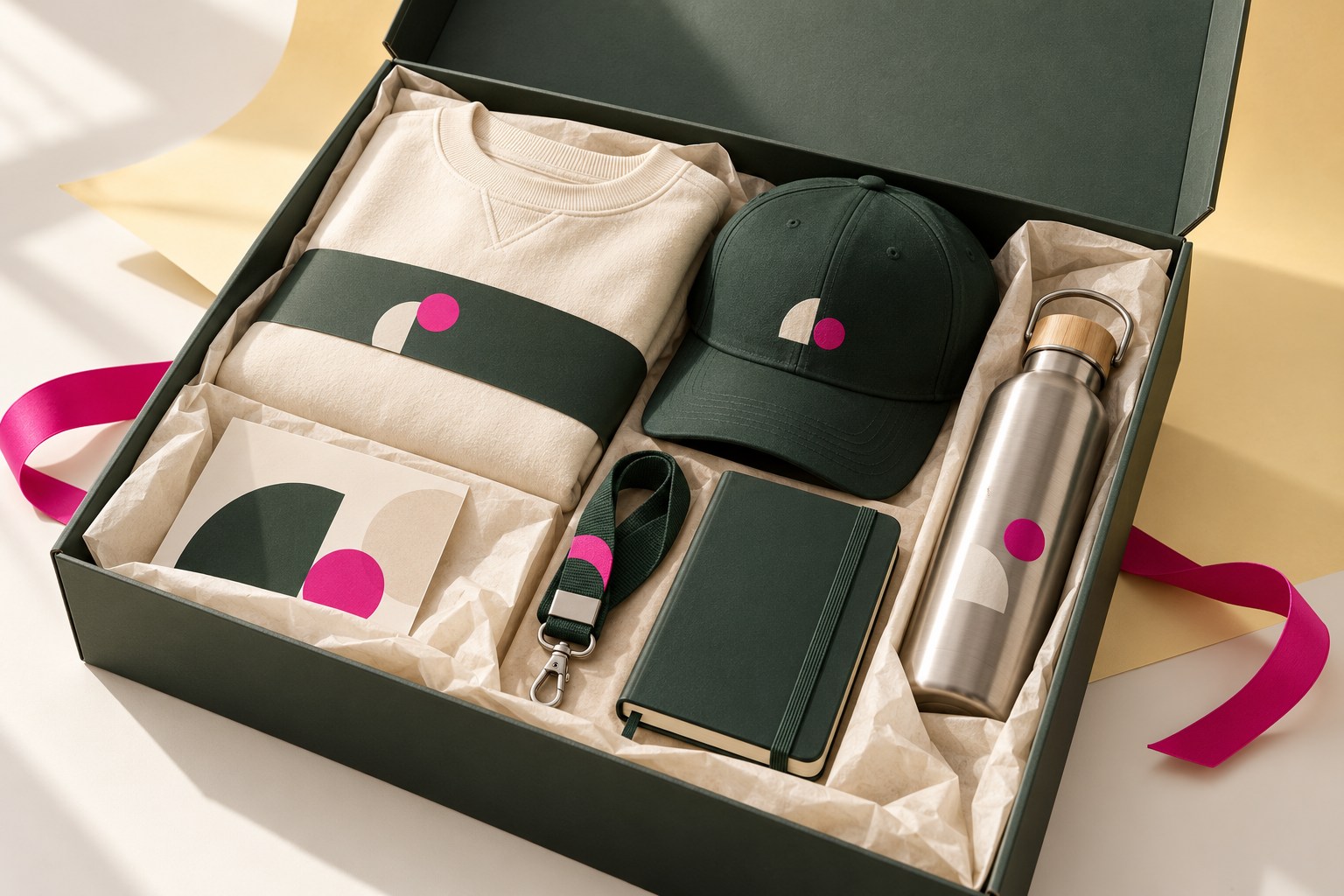
A strong employee welcome kit makes company culture tangible. It arrives at the right moment, connects every item to a real value or ritual, and is designed around useful products and reliable delivery — not a random stack of branded gifts.
A welcome kit is a message before it is a collection of products
An employee welcome kit is often described by what is inside it: a hoodie, a notebook, a bottle, a tote bag. But a good kit says something more important: how the team behaves, what it notices and what it values.
That makes the kit part of onboarding, not simply corporate gifting. Its timing, language, packaging and delivery matter as much as the products. The four examples below are useful because each turns an abstract idea about culture into a physical experience. They are also historical references, not current programme specifications: the AXA case was recognised in 2023, while the Mailchimp, Dropbox and Ogilvy stories were published in the mid-2010s.
1. AXA: turn the first week into a sequence
AXA's "The AXA Hello" was built as a week-long onboarding experience for new starters. According to the RAD Awards 2023 case study, the welcome pack contained five gifts to be opened across the first five days. Each object represented a part of the company's culture, and QR codes connected the physical gifts to digital content.
The products included a mood-lamp speaker, a notebook, socks, a desk plant and an aromatherapy item. The stronger idea is pacing: instead of communicating everything in one reveal, AXA gave each day a theme and a reason to engage.
The published award entry reports almost 900 packs delivered in the first six months and says more than half of surveyed new joiners felt closer to the AXA brand and purpose. Those figures belong to AXA and its campaign context; they are not a universal benchmark. What can travel to another brand is the structure: one cultural message, one object and one action at a time.
2. Mailchimp: make belonging a two-way gesture
Mailchimp's recruiting team used an offer kit to bridge the quiet period between a verbal acceptance and the first day. In its 2016 company story, Mailchimp described sending T-shirts, stickers and buttons together with a card asking, "Will you be my coworker?" A stamped return envelope invited the future employee to answer.
The replies became a "Wall of Yes" in the office. That small mechanism changed the kit from a one-directional gift into an exchange. It also matched Mailchimp's playful culture: the tone was warm, slightly odd and unmistakably theirs.
Today the response does not have to be a postcard. It could invite someone to choose a patch, share a playlist or select a cause for a donation. The principle is the same: give the recipient a role in the story.
3. Dropbox: choose a symbol people can retell
In a 2016 archive on workplace culture, Mollie West Duffy documented a Dropbox offer ritual built around a cupcake kit sent to a future employee's home. The cupcake referred to one of the visual symbols Dropbox used for its values and expressed a willingness not to take itself too seriously.
A welcome kit does not need ten products to feel substantial. One ownable symbol can be more memorable than a catalogue of standard items. The test is simple: can the recipient explain why this object belongs to this company in one sentence?
There is an operational caution here. Food adds ingredient, allergen, dietary, shelf-life and cross-border shipping requirements. If those cannot be managed reliably, keep the cultural symbol but change the format: a recipe card, a locally fulfilled voucher or a durable object inspired by the same idea.
4. Ogilvy Cape Town: turn history into a usable guide
Ogilvy & Mather Cape Town called its welcome set an "Induction Box". The MOO case article describes a concept inspired by David Ogilvy's writing and the agency's eight habits of highly creative communities. The box used copy and physical details to explain what the organisation stood for and how a new colleague could take part.
The lesson is not to fill packaging with company history. It is to edit history into useful signals: a principle for making decisions, a story that explains a ritual, or a prompt that helps someone start a conversation. A new employee should leave the box knowing what to do, not only what happened before they arrived.
What the four examples have in common
The products are different, but the design logic is consistent:
- Culture comes first. Each kit starts with a value, behaviour, symbol or ritual — then chooses the object.
- Timing is designed. The experience begins before day one, unfolds during the first week or supports a specific onboarding moment.
- The recipient participates. A QR journey, a returned card, a shared ritual or a clear prompt creates an action.
- The story is repeatable. Someone can explain why each item exists without reading a brand manual.
This is also why more expensive does not automatically mean more effective. Relevance, coherence and execution usually create more value than product count.
How to brief an employee welcome kit
Before asking for product options, answer four questions.
1. What should a new colleague understand?
Choose one primary message: "we care about craft", "we make complex work feel human", "we learn in public" or another idea that is true in daily work. Avoid trying to compress the whole employer brand into one box.
2. When should the experience happen?
An offer-acceptance gift has a different job from a first-day desk kit or a remote-work setup. The date determines the address collection process, approval deadline, fulfilment model and contingency stock.
3. What will genuinely be used?
Wearables need an inclusive size range and a privacy-aware way to collect sizing data. Food needs ingredient and expiry control. Plants are fragile and may be restricted in transit. Electronics add certification, battery and recycling considerations. A smaller set of well-resolved items is safer than a crowded box with hidden operational risks.
4. Can the system repeat at 20, 200 and 2,000 hires?
Plan how names, addresses, sizes, stock, replacements and tracking will be handled. Keep core items stable and create controlled variations for location, role or season. The best onboarding merch works as a programme, not a one-off photo shoot.
Build the kit from the culture out
At CTRL MERCH, we approach an employee welcome kit as a small branded system: concept, product selection, design, sampling, packaging and delivery have to support the same message. The goal is not to put a logo on everything. It is to create a useful first physical proof of how the company thinks.
If you are planning onboarding merch for a team in Barcelona or across Europe, start with the moment, the audience and the operational reality. The right products become much easier to choose once those three things are clear.